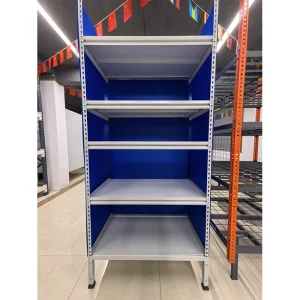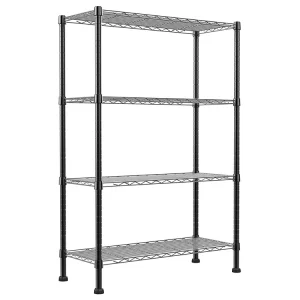
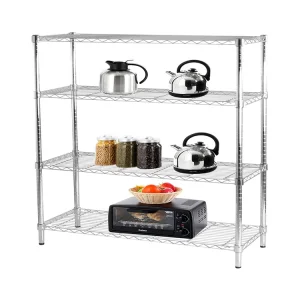
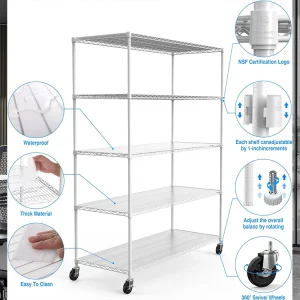
Established in 2016, Guangdong Aomeijia Metallic Products Co., Ltd. has cemented its position as a leading global manufacturer and exporter specializing in industrial shelving systems, automated warehouse storage racks, heavy-duty pallet racks, and customized structural steel storage applications.
Operating a modernized manufacturing base exceeding 28,000㎡, our vertically integrated facilities encompass complete cycles of modern metal fabrication—ranging from cold rolling, precision stamping, robotic structural welding, to automated electrostatic thermosetting powder coating and chrome plating lines. With over 12 years of industry experience in the warehouse equipment sector and 8 years of dedicated global export experience, we manage an annual export revenue of approximately US$18 million.
We serve a diverse ecosystem of global partners, including warehouse operators, logistics companies, e-commerce giants, retail networks, industrial system integrators, and project contractors. By anchoring our development in structural engineering, rigorous material testing, and advanced automation, we continuously push the boundaries of industrial storage load-bearing optimization.
Our research and development division is comprised of 18 highly experienced engineers dedicated to advancing metallurgical load tolerances, optimizing structural stability under dynamic forces, and designing AGV-compatible racking frames. Annually, we launch approximately 120 new products and optimized storage solutions tailored to the structural and safety demands of international industrial operations.
The rise of automated supply chains, third-party logistics (3PL) aggregators, and dark e-commerce fulfillment hubs has triggered a paradigm shift in how warehouse storage systems are engineered. Static warehouse shelving has evolved into highly optimized dynamic systems designed to maximize volumetric efficiency. As premium industrial exporters, we analyze how warehouse floor space cost factors force modern companies to move from standard horizontal storage to high-density vertical systems.
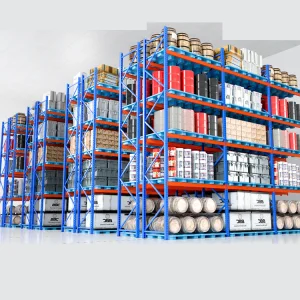
Industrial storage systems must reconcile two competing factors: physical footprint minimization and load capacity maximization. Modern warehouses must support up to several tons per rack bay while facilitating speed of entry and retrieval. Storage systems are no longer passive steel arrays; they are integrated components of high-velocity intralogistics ecosystems. Consequently, material selection, mechanical stability, and precision tolerances have become the differentiators in global supply chain security.
"The modernization of supply chains relies on vertical density and structural reliability. In the high-density warehouse storage era, deflection control and precision metallurgy are critical metrics."
As a seasoned industrial storage manufacturer, our engineering teams construct storage systems using high-grade, cold-rolled carbon steel, primarily focusing on Q235 and Q355 steel grades. These materials are chosen for their optimal yield strength, weldability, and structural ductility, enabling structures to handle substantial load variances without permanent structural deformation.
Racking structures must comply with stringent international standards, including the Rack Manufacturers Institute (RMI) standards in North America and FEM 10.2.02 standards in Europe. Under full design load, the maximum allowable vertical deflection of any structural beam must not exceed 1/200th of the clear span length (L/200), or L/300 in highly critical applications. Structural engineers use Finite Element Analysis (FEA) to simulate complex loading conditions, including seismic, impact, and asymmetrical configurations, to ensure safety margins remain above a factor of 1.5.
| Technical Characteristic | Standard Requirement (FEM / RMI) | Aomeijia Engineering Specifications |
|---|---|---|
| Steel Grade Selection | ASTM A1011 / Q235B Minimum | Q235B and Q355B structural steel certified |
| Weld Penetration Ratio | ≥ 75% nominal thickness | ≥ 85% penetration verified via ultrasonic testing |
| Deflection Limit (under maximum load) | L / 180 of structural span | L / 240 (standard) to L / 300 (critical applications) |
| Coating Thickness (Epoxy Powder) | 40 - 60 microns | 60 - 90 microns (tested via dry film thickness gauge) |
| Salt Spray Performance (Corrosion) | Up to 240 Hours | Up to 500 Hours (specific to green epoxy NSF lines) |
Exposed warehouse steel is prone to rapid oxidation in humid or chemically aggressive environments. We combat this using three protective finishes:
Different industrial applications require specific structural properties. We design and manufacture custom products tailored to these distinct environments:
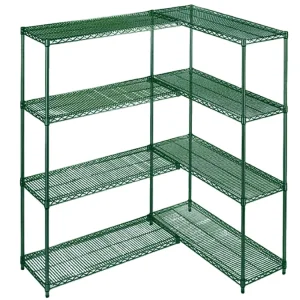
In sub-zero environments (reaching -30°C), standard carbon steel can become brittle. We use specialized, low-temperature carbon steel options combined with high-durability epoxy finishes. Our green epoxy wire shelving systems are NSF-approved, maintaining structural flexibility and resisting moisture, mold, and microbial growth in cold storage applications.
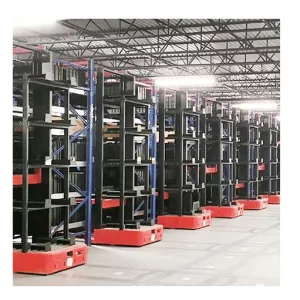
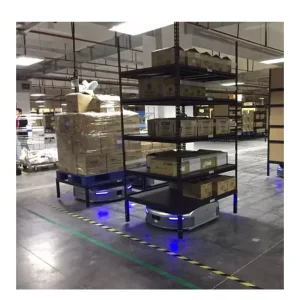
Automated Guided Vehicles (AGVs) require precise spatial accuracy. A deviation of just 2-3mm can cause robotic capture errors or sensor faults. Our AGV supporting racks and mobile shelf systems are engineered with tolerances below 1mm. We reinforce vertical columns and use high-grade rolling casters to ensure flat, stable travel paths for automated transport units.
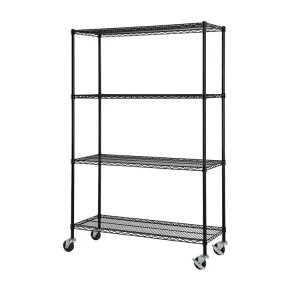
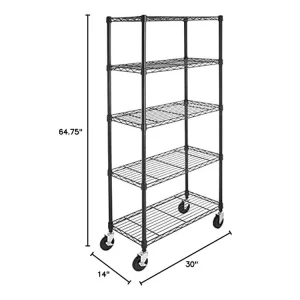
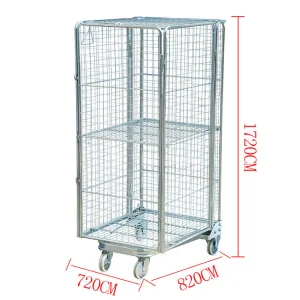
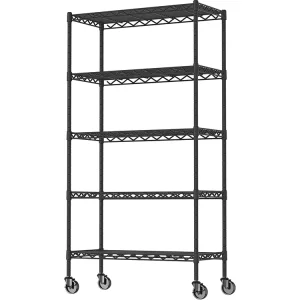
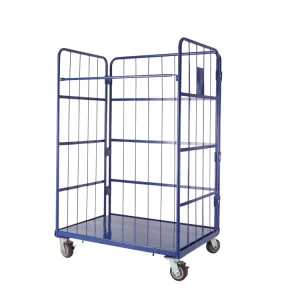
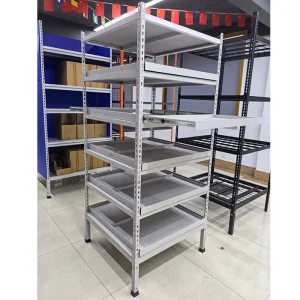
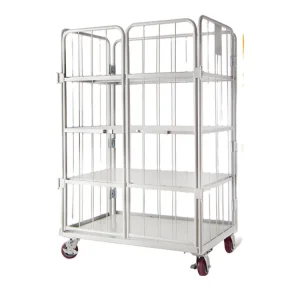
E-commerce hubs require dynamic product turnover. We address this demand using multi-tier adjustable chrome wire shelves and mobile roll containers on wheels. These configurations enable swift layout adjustments without requiring specialized tools, facilitating fast order picking, shipping routing, and return sorting.
As the world's leading exporter of industrial storage systems, China's manufacturing sector relies on extensive supply chain integration, raw material access, and advanced automation. Guangdong Aomeijia leverages these regional advantages to provide global partners with stable lead times and competitive pricing.
Our facility is situated in Guangdong, a key global hub for metal fabrication. We maintain direct relationships with over 1,200 trusted supply chain partners, guaranteeing a steady supply of high-grade raw steel coils and wire rods, even during global market shifts. This deep supply integration allows us to keep manufacturing costs stable and insulate partners from price volatility.
Additionally, our production floor utilizes advanced automated manufacturing technologies, including robotic multi-spot welding, continuous roll-forming machines, and automated powder coating lines. These systems reduce labor dependencies, lower production costs, and maintain consistent welding strength across large-volume production runs.
Maintaining safety and structural integrity in warehouse operations requires a comprehensive quality management system. Our quality team consists of 45 professional inspectors who monitor every phase of production, from raw material receipt to final container loading.
Our quality assurance framework includes:
As smart warehousing systems continue to develop, we are preparing for the future of industrial storage by adapting our manufacturing technology:
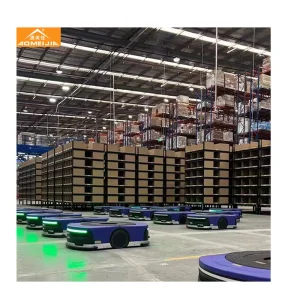
We are refining our mobile shelf designs to integrate seamlessly with Autonomous Mobile Robots (AMRs) and AGVs. This includes developing standardized base plate locking systems, precision guidance tracks, and structural profiles designed for automated transport.
To support global environmental targets, we are reducing our environmental footprint by using VOC-free powder coatings, optimizing energy recovery in our curing ovens, and increasing the use of recycled steel in our structural components.
Our R&D team is designing advanced column profiles with complex geometries. These designs increase load capacities while reducing steel weight, helping our clients lower freight costs and simplify on-site installation.
 AomeRack